


Do Kids With Autism and ADHD Think Differently?

Understanding Neurodivergence in Children — And Why It Changes Everything
There is a particular kind of confusion that settles over parents quietly. Not the loud, urgent kind that sends you rushing to an emergency room, but the slow, accumulating kind. The kind that lives in the pause after your child’s teacher says “he’s a little different.” In the moment you watch your child notice something no one else in the room noticed. In the bedtime question you can’t quite answer: why does everything feel so much harder for them?
Most parents who arrive at words like autism or ADHD don’t arrive suddenly. They arrive after months, sometimes years, of watching, wondering, and quietly worrying. And the first thing they deserve to hear is this: your child is not broken. Their brain is just built differently. And different, understood properly, is not a disadvantage.
A Different Brain, Not a Damaged One
Neurodivergence, a term that includes Autism Spectrum Disorder and ADHD, is not a flaw in how your child developed. It is a variation in how their brain is and how it processes the world around them.
The CDC estimates 1 in 36 children has autism. ADHD affects roughly 1 in 10 school-aged children globally. These are not rare conditions at the edges of childhood. They are woven into the everyday fabric of classrooms, playgrounds, and dinner tables across the world, and quite possibly, your own home.

What research from the Child Mind Institute now tells us is that autism and ADHD share more neurological common ground than we once understood. Overlapping brain connectivity patterns, shared genetic markers, a similar relationship with attention, sensation, and emotion. The two conditions are closer cousins than they are strangers.
Their brains are not underperforming. They are running a different operating system entirely.
Guide to Understanding Autism Spectrum Disorder
What It Looks Like From The Inside
You have probably already seen it, even if you didn’t know what you were looking at.
The child who disappears for hours into a single subject with a focus so complete it borders on extraordinary, but cannot move on when it’s time. The one who is stopped in their tracks by the scratch of a fabric tag but barely flinches at a fall. The one who thinks in systems, in pictures, in patterns, in ways that leave you equal parts amazed and bewildered.
These are not behavioural problems. They are not signs of bad parenting or weak discipline. They are a different, entirely valid way of experiencing a world that was largely not designed with them in mind.
AuDHD: Something Most Parents Haven’t Heard Yet
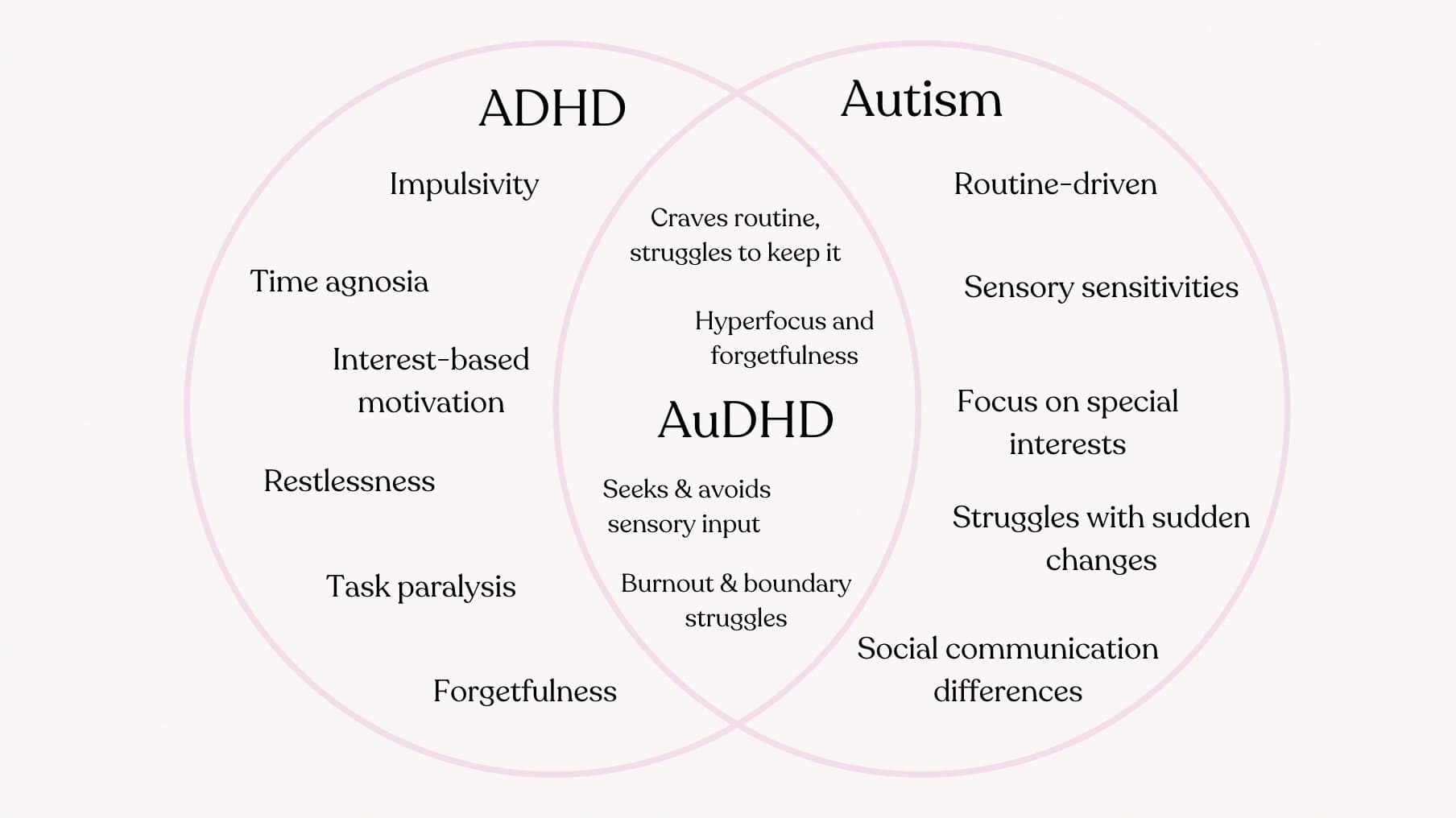
Here is where it gets more layered. Autism and ADHD do not always arrive separately. A meta-analysis of over 50 studies found that 39% of people with autism also have ADHD, a combination now being called AuDHD.
A child with AuDHD might need routine to feel safe but grow restless inside that same routine. They might reach for connection with both hands but find the act of socialising genuinely exhausting. They live, in some ways, between two worlds at once, and the confusion this creates, for them and for the people who love them, is real.
If your child has always seemed to carry contradictions inside them, this might be why.

ADHD vs ADD: What’s the Difference, and Why Does It Matter?
The Part That Gets Lost in the Hard Days
In the middle of the meltdowns, the school calls, the nights spent reading forums at midnight, we miss something important.
Many of the same neurological traits that make life harder for neurodivergent children are the very same traits that make them exceptional. Children with ADHD show higher rates of creative and divergent thinking. Children with autism frequently demonstrate pattern recognition, memory, and systematic thinking that sits well beyond their years. The struggle and the strength are not opposites. They grow from the same root.
Your child is not behind. They are on a path that looks different from the one you expected. That is not the same thing as the wrong path.
What You Can Do Right Now
Trust what you are seeing. Early understanding, not labelling, not judgement, but genuine understanding, changes outcomes in ways that are well documented and deeply significant. The earlier a child is truly seen, the better ready they are to navigate the world on their own terms.
At BabyMD, we are here for exactly this. The questions you are not sure how to ask. The signs you are not sure how to read. We will help you find clarity, with warmth, without jargon, and without making you feel like you should have figured this out sooner.
You are already asking the right questions. That matters more than you know.
Found this helpful?
Share this article with other parents who might benefit from this information.