
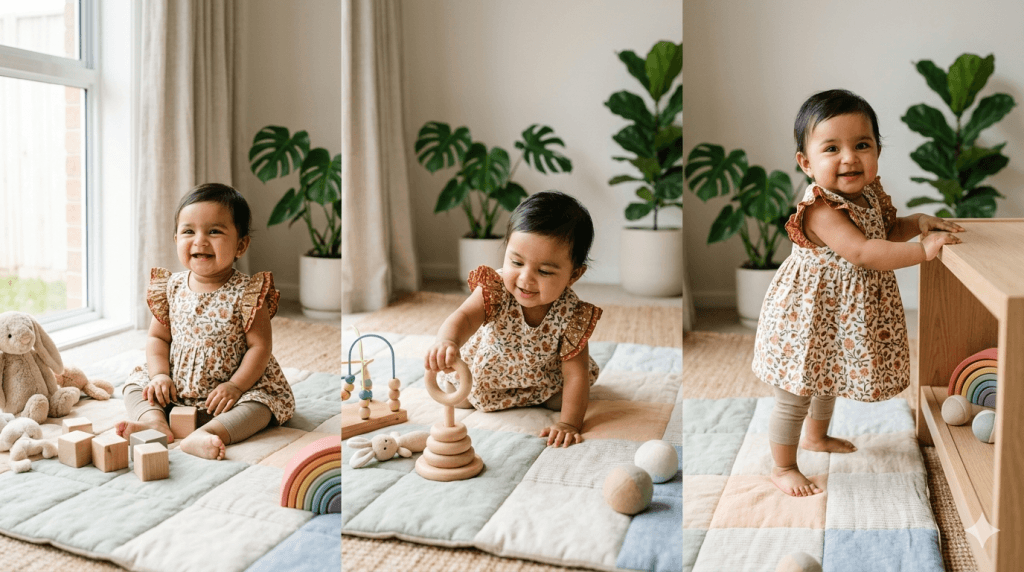


A Parent’s Guide: Is My Child Meeting Their Milestones?

Is My Child Meeting Their Milestones?
1 in 10 children in India has a developmental delay. That is not a rare edge case — it is a classroom, a neighborhood, a family gathering. And yet most of these delays are not identified early. Not because parents do not care, but because they do not always know what to look for — or at what age to expect it.
The first year of life is the most critical window for developmental monitoring. Your baby goes from a newborn who cannot lift their own head to a curious, cruising, communicating little person in just twelve months. Each stage of that journey has a shape to it. Knowing that shape — and spotting when something is consistently missing — is what makes early intervention possible. And early intervention, the research is clear, changes outcomes in ways that nothing else can.
What Are Developmental Milestones — And How Flexible Are They?
Developmental milestones are the skills and behaviours a baby is expected to show by a certain age — benchmarks that help parents and doctors track whether a child is broadly on track across four key areas: gross and fine motor skills, language and communication, social and emotional development, and cognitive growth.
They are not a rigid checklist. Each baby is unique and develops at their own pace — these milestones are guidelines, not strict deadlines. A range of a few weeks around typical timings is completely normal. What developmental monitoring looks for is a pattern — whether a child is broadly tracking the expected arc, or whether there are consistent gaps across one or more areas that warrant a closer look.
Month by Month: What to Expect in the First Year
0–2 Months
In the earliest weeks, your baby’s behaviour is largely driven by reflexes — rooting, grasping, the startle response. But meaningful development is already underway.
By 2 months, most babies will begin to lift and hold their head briefly when lying on their tummy. They will start to follow a face or a bright object with their eyes, respond to sound by stilling or turning, and produce their first cooing sounds. Most importantly — they will begin to smile in response to your face.
Watch for: Social smile by 6 weeks to 2 months, eyes tracking faces, cooing sounds, some head lifting during tummy time.
2–4 Months
This is when babies start to feel more interactive. They begin to hold their head steadier, push up on their forearms, and track objects and people across a wider range. They respond more vocally — cooing back when you talk to them, beginning the early back-and-forth of conversation.
By 4 months, lack of head control is a red flag for possible neuromuscular concerns. If your baby’s head is still flopping with no control around this age, mention it at your next visit.
Watch for: Improving head control, social responsiveness, vocalising back during “conversations”, tracking objects smoothly.
4–6 Months
By 4 to 6 months, babies are becoming far more physically active. At 4 months, most babies raise their head to 45 degrees when lying on their tummy and show better control when pulled to sit. By 6 months, most can roll from back to tummy and back again, and sit with support.
Socially, this is a rich period. Babies begin to laugh, squeal with delight, and show clear recognition of familiar faces. They reach for and bat at objects, begin to transfer things between hands, and babble with increasing enthusiasm.
Watch for: Rolling, sitting with support, reaching for objects, laughing, babbling, recognising familiar faces.
6–9 Months
By this stage, most babies are sitting without support, beginning to bear weight on their legs when held standing, and exploring objects actively with their hands and mouth. Babbling becomes more varied with increasing pitch changes and sound repetition.
This is also a key period for social and emotional development. Stranger anxiety — becoming wary around unfamiliar people — typically appears around 6 to 8 months. This is a normal, healthy sign that your baby has formed secure attachments to familiar caregivers.
Watch for: Sitting independently, transferring objects between hands, stranger anxiety, varied babbling, beginning to respond to their name.
9–12 Months
The final stretch of the first year is one of the most exciting. Most babies are pulling themselves to stand, cruising along furniture, and some are taking first independent steps. The pincer grasp — picking up small objects between thumb and forefinger — typically appears around 9 to 10 months.
Language is accelerating too. Babies begin to understand simple words — “no”, their own name, “mama”, “dada” — and many say their first meaningful word close to their first birthday. Pointing is one of the most important milestones to watch for: by 12 months, most babies point to show interest in something or ask for something they want. It is a foundational social communication skill, and its absence is worth noting.
Watch for: Pulling to stand and cruising, pincer grasp, first words or word-like sounds, pointing, waving, responding to simple instructions.

What Is a Developmental Assessment — And What Does It Involve?
A developmental assessment is a structured evaluation of how your baby is progressing across all four developmental domains: motor skills, language, social and emotional development, and cognitive ability.
In routine paediatric care, your doctor will conduct brief developmental surveillance at every well-baby visit — observing your baby, asking you questions, and checking milestones against age-appropriate expectations. This is different from a full developmental assessment, which is more detailed and usually initiated when a concern has been flagged.
A full assessment typically involves a trained developmental paediatrician or therapist spending time directly with your baby, using validated tools to observe and evaluate their abilities across all areas. Parents play a central role — your observations and instincts are considered as important as what the clinician sees in the room.
Read more: Autism Early Signs for Parents
Signs That Warrant an Earlier Assessment
While most developmental variation is normal, certain signs should prompt a conversation with your doctor sooner rather than at the next scheduled visit.
Seek an assessment if your baby:
- Does not smile responsively by 2 months
- Shows no improvement in head control by 4 months
- Does not follow moving objects with their eyes by 3 months
- Does not babble or make sounds by 6 months
- Does not reach for or grasp objects by 6 months
- Shows no interest in faces or people
- Does not sit with support by 9 months
- Does not respond to their name by 9–10 months
- Does not point, wave, or use gestures by 12 months
- Does not say any single words by 12 months
- Loses any skill they previously had — at any age, this always needs prompt attention
One important note: do not wait for your baby to “fall further behind” before raising a concern. The earlier a developmental difference is identified, the wider the window for intervention. Raising a concern early never does harm — missing one can.
A Note on the Indian Context
Indian babies develop within the same broad framework of milestones as children worldwide. However, Indian research consistently finds that language delay is the most commonly identified area of concern — with a prevalence of 10% in studies from rural and semi-urban settings, followed by fine motor delay at 5%. Maternal education and awareness of age-appropriate milestones were identified as significant factors associated with delay in multiple Indian studies — meaning that in many cases, delays go unnoticed simply because families do not know what to look for at each stage.
You reading this already puts you ahead of that curve.
You Know Your Baby Best
Developmental assessments are not about finding something wrong. They are about understanding your baby — getting a full picture of how they are growing, what they are doing well, and where they might benefit from a little extra support.
If something feels off — a milestone that seems consistently absent, a change in your baby’s behaviour, or simply a persistent gut feeling — trust it. Parents who raise concerns are right far more often than they are dismissed.
At BabyMD, our Developmental Assessments & Therapies team is experienced in evaluating babies from the earliest months of life. If a concern is identified, everything your child might need — from speech therapy and occupational therapy to parent guidance — is available under one roof, with no need to navigate multiple referrals on your own.
For general developmental concerns or a well-baby check, speak to one of our paediatricians by calling 6366447363. For developmental assessment or therapy-related queries, our specialist team is available on 6366447362. You can also book an appointment online at a time that works for you.
The first year goes fast. If something is giving you pause, now is always the right time to ask.
Found this helpful?
Share this article with other parents who might benefit from this information.